
Deterministic Bucketing and Weighted Distributions: How Percentage Rollouts Control Exposure
A technical deep dive into how Zenmanage Percentage Rollouts keep user exposure stable over time with deterministic bucketing and weighted distribution across rollout stages.

The hard part of percentage rollouts is not moving a slider. The hard part is trusting that the same person does not bounce between old and new behavior as you expand exposure.
This post explains how Zenmanage approaches that problem with deterministic bucketing and weighted distribution. You will see what to trust conceptually, how manual and automatic stages work in practice, and where to go for implementation details.
Conceptual Model: What You Need to Trust
At runtime, each evaluation ends in one of two paths:
- Rollout path: user receives the rollout target value.
- Fallback path: user receives the non-rollout target value.
The rollout percentage is a weight between those two paths. At 20%, the system is serving a 20/80 weighted split: 20% of eligible contexts go to the rollout path, and 80% go to fallback.
The key property is deterministic assignment. If a context is in the 5% cohort today, it remains in as you move to 10%, 20%, 50%, and 100%. Expansion adds new contexts on top of the existing cohort instead of replacing it.
End-to-End Example: One Flag, One Identifier, Multiple Stages
Imagine you are rolling out a new checkout flow behind a flag. Your context identifier is the user ID, and your rollout starts at 1%.
A user with ID usr_4821 is evaluated and lands inside the first 1% bucket range. That user now receives the rollout target value.
Next day you advance to 2%. usr_4821 still receives the rollout value, and a small additional cohort is added. Then you advance through 5%, 10%, 20%, and 50% the same way. Existing rollout users stay in; only new users are added as percentage increases.
By the time you reach 100%, everyone receives the rollout value and the weighted split becomes 100/0.
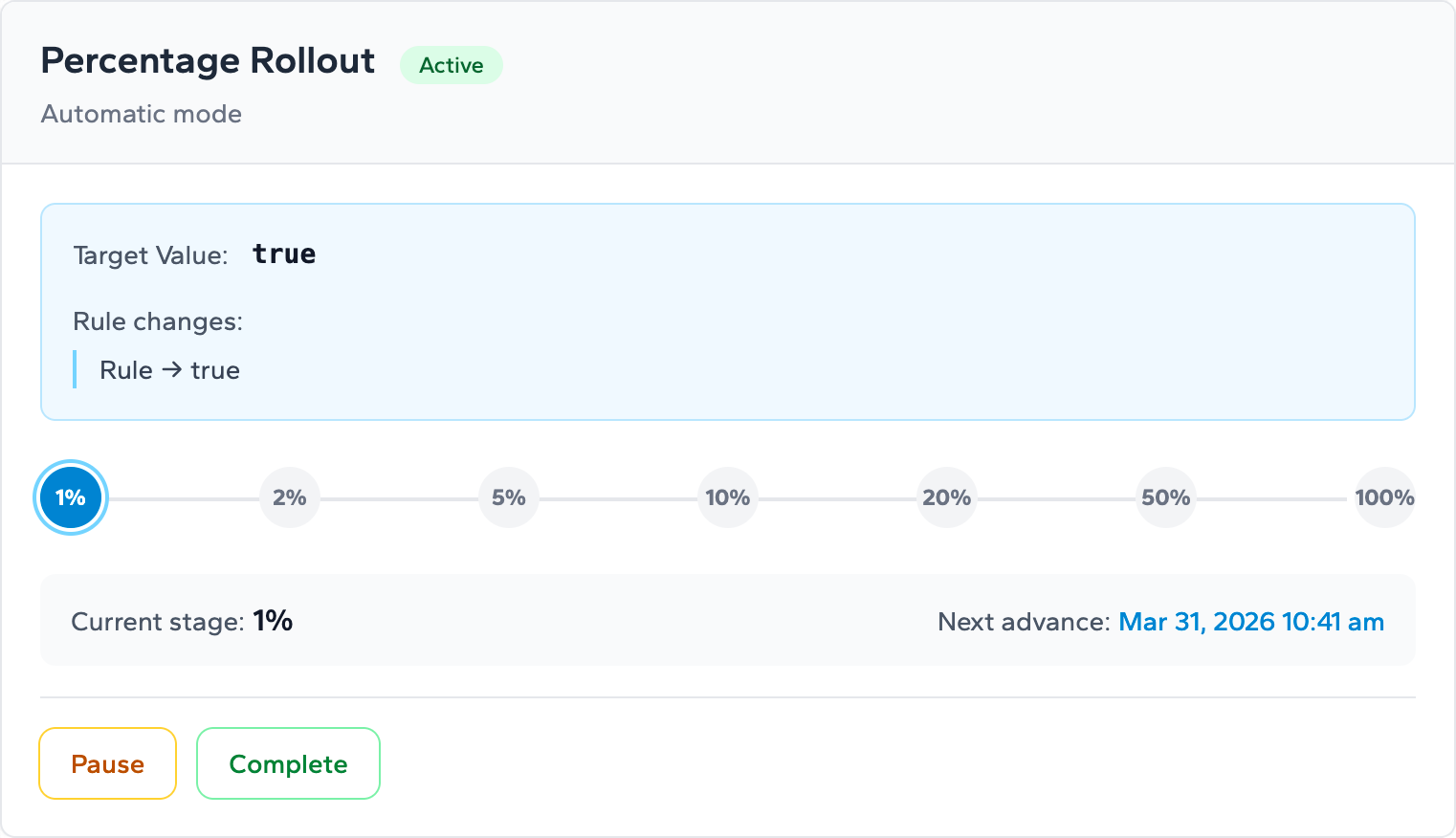
This is the practical sequence used for automatic progression in the product:
- 1%
- 2%
- 5%
- 10%
- 20%
- 50%
- 100%
Manual vs Automatic Progression
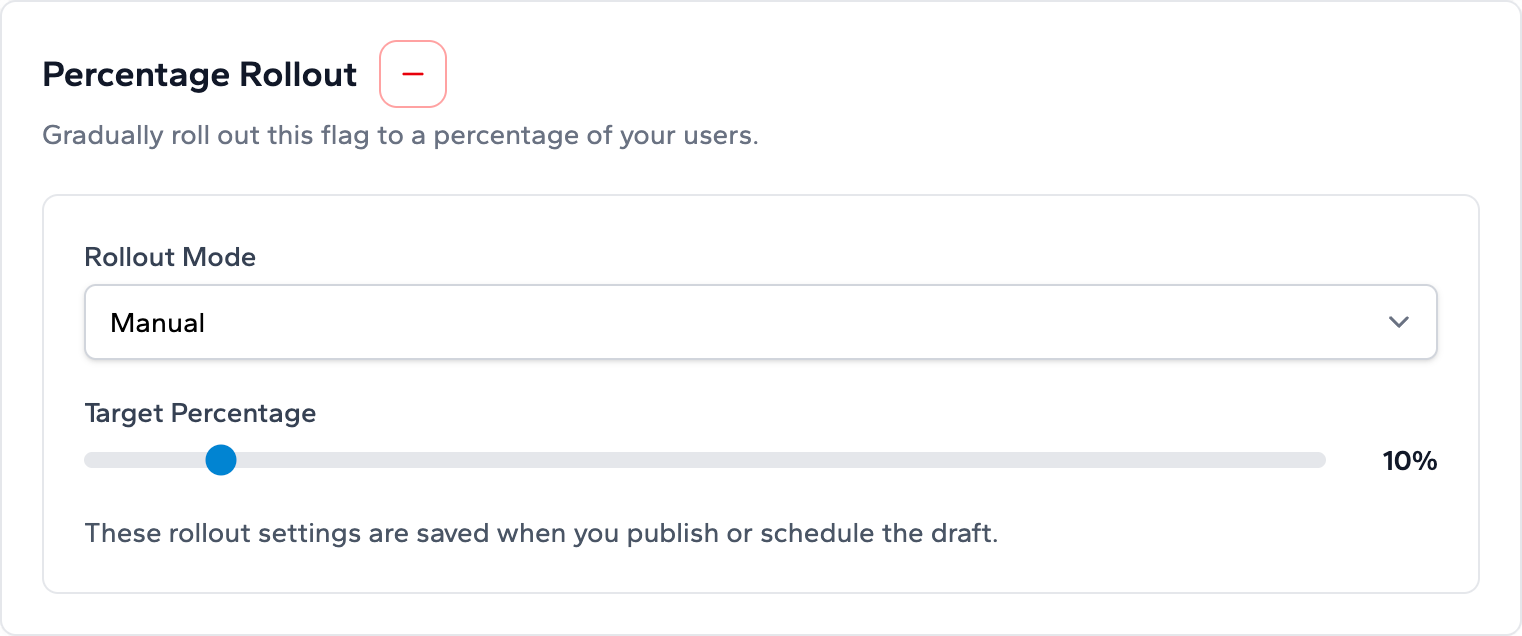
In Manual mode, your team decides when to advance from one percentage to the next based on monitoring and business context.
In Automatic mode, Zenmanage advances using your configured stage sequence and timing. You can still pause, resume, or complete early if needed.
The exposure model is the same in both modes. What changes is who drives timing: your team or the schedule.
Deterministic Does Not Mean Overpromising
Deterministic bucketing solves consistency and exposure control. It does not, by itself, guarantee statistical significance, experiment analysis, or causal attribution.
In other words: Percentage Rollouts are a safe release control mechanism first. If you need experiment-grade analysis, pair rollout data with your analytics and experimentation workflow.
Where Concept Ends and Implementation Details Begin
Conceptually, you only need to remember three rules:
- Every evaluation goes to rollout or fallback path.
- The percentage is a weighted split between those paths.
- Assignment is stable for a given identifier and rollout configuration.
Implementation-specific details, such as hashing internals, salts, and scheduler behavior, are engineering concerns documented separately so product decision-making stays simple and reliable.
Continue Reading
If you want to apply this model in production, start here:
- Progressive Rollouts Playbook - full lifecycle guidance from configuration to completion.
- Progressive Rollouts capability page - product overview and key capability details.
- Contexts and Attributes - how stable identifiers and attributes shape targeting and rollout behavior.
- Canary Release Playbook - practical monitoring and go/no-go guidance for early stages.